Edge AI Cost in 2027: Pricing, PoC vs Production and TCO
 Subham Agrawal24 November 202624 min read
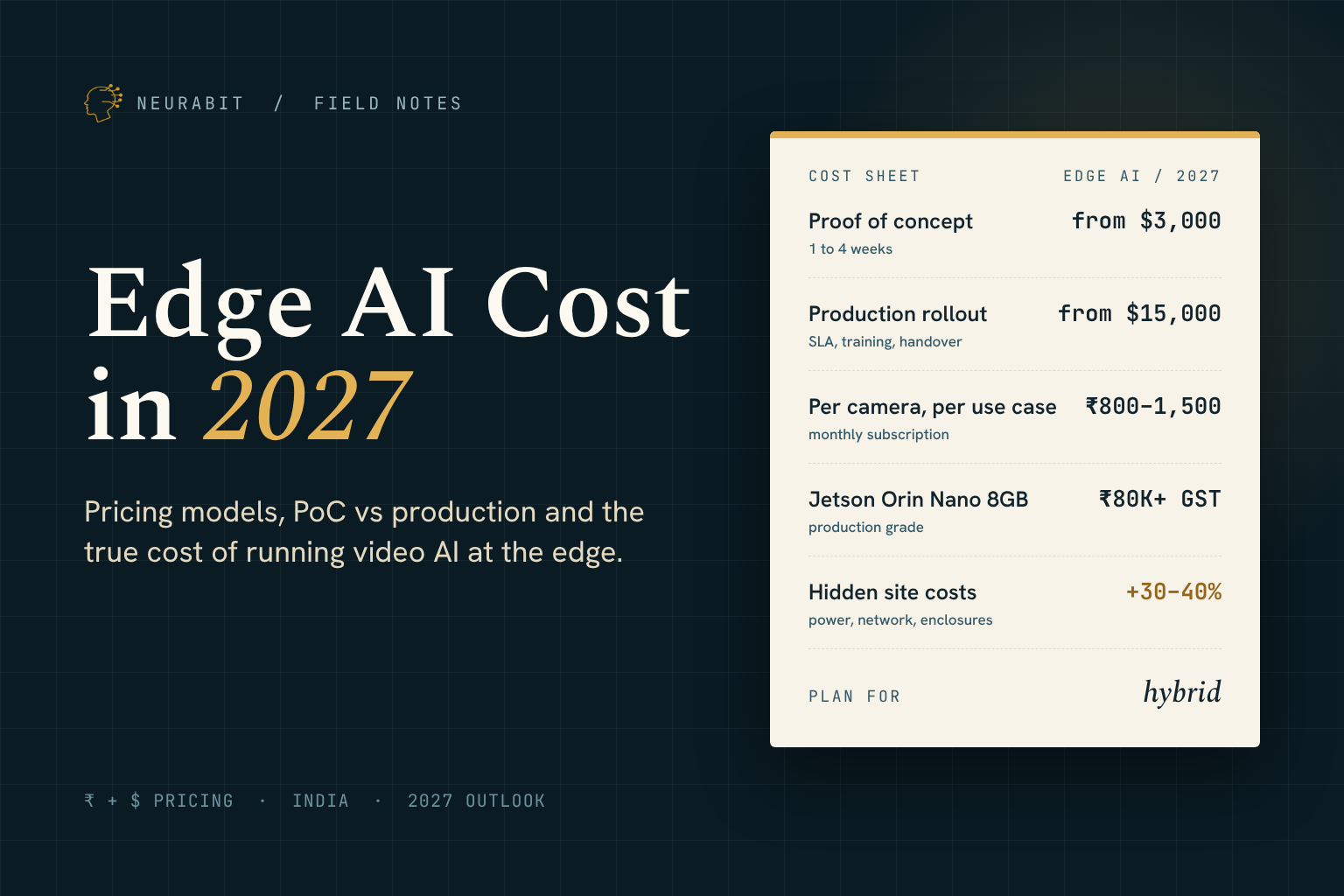
If you are planning an edge AI budget for 2027, edge AI cost comes down to four numbers: what the proof of concept costs, what the production rollout costs, what you pay every month per camera or device, and what the hardware at each site costs. Most articles on this topic give you only the last one, priced in US dollars, for a cloud you are not using.
This guide gives you all four, with the price ranges we quote to our own clients at Neurabit, an edge AI and video analytics company that builds and runs these systems in factories, utilities and public infrastructure. The prices are what we quote as 2026 closes, which is the baseline your 2027 budget starts from. At the end, we set out where we expect edge AI costs to head in 2027.
Edge AI means running the AI model on a device at the site, such as an NVIDIA Jetson or a Raspberry Pi next to the cameras, instead of sending data to a cloud server for inference. Edge AI cost is the total cost of owning that system: build, hardware, deployment, subscription or support, and the hidden site work that most budgets leave out.
Edge AI Cost at a Glance
All rupee figures assume ₹85 to the dollar. Hardware prices exclude GST unless stated.
| Cost item | Typical range | What drives it |
|---|---|---|
| Proof of concept (PoC) | From $3,000 (about ₹2.5 lakh), 1 to 4 weeks | Use case complexity, number of cameras, data available |
| Production rollout | From $15,000 (about ₹12.75 lakh) | Sites, integrations, SLA level, training and handover |
| Video analytics subscription | ₹800 to ₹1,500 per use case per camera per month | Number of use cases, camera count, annual vs monthly billing |
| Edge hardware, Jetson Orin Nano 8GB | ₹50,000 + GST (dev kit) to ₹80,000+ + GST (production grade) | Memory prices, carrier board, enclosure, storage |
| Edge hardware, Raspberry Pi 5 | ₹13,900 (4GB) to ₹20,200 (8GB) | Board only, before accelerator, case and storage |
| Hidden site and integration costs | 30% to 40% of project cost | Power, network, enclosures, site visits, retraining |
| Cloud GPU for inference (alternative) | About $0.58 per hour per NVIDIA T4 in AWS Mumbai | Cameras per GPU, frame rate, uptime |
If you remember one thing from this table: the subscription or retainer is predictable, the hardware has become more expensive in 2026, and the hidden 30% to 40% is where budgets fail.
How Edge AI Vendors Charge: The Four Pricing Models
A common question from buyers is how edge AI platforms charge for data processing. The short answer is that most do not. Because inference happens on the device at your site, there is no per-gigabyte or per-inference meter running in a data centre. Instead, vendors price by what they deploy and support: cameras, devices, use cases or engineering time.
These are the four models you will see today.
1. Per-camera subscription (software as a service)
You pay a monthly fee for each camera stream and each AI use case running on it, such as PPE detection, intrusion or vehicle counting. This is how we price our AI video management system.
- Typical price: ₹800 to ₹1,500 per use case per camera per month, with discounts for annual billing
- Includes: software updates, model improvements, monitoring and support
- Best for: standard use cases on existing CCTV, multi-site rollouts, buyers who prefer operating expenditure over capital expenditure
2. One-time build plus monthly retainer
For a custom problem, such as a defect type nobody has a ready-made model for, the vendor charges a one-time fee to build and deploy the system, then a monthly retainer to support, retrain and maintain it. This is how we price custom solutions.
- Typical price: production builds start at around $15,000 (about ₹12.75 lakh). The monthly retainer typically starts at around 20% of the total project cost, and from about $1,500 to $2,000 (about ₹1.3 to ₹1.7 lakh) a month for smaller projects
- Includes: the build, enterprise support, SLA commitments, training, handover and a dedicated single point of contact (SPOC)
- Best for: custom computer vision, robotics and inspection systems where the model and integrations are specific to your process
3. Per-device or per-site licence
Some platforms charge a fixed annual licence per edge box or per site, regardless of how many cameras or models run on it. It is simple to budget, but you can end up paying for capacity you do not use at small sites.
4. Usage-based cloud pricing
Cloud vision APIs and GPU instances charge per hour, per image or per token. This model suits intermittent workloads, such as analysing a few images an hour. For continuous video it gets expensive fast: an independent analysis by Fora Soft puts continuous cloud video analytics at anywhere from about $15 to $4,320 per camera per month, depending on the method (Fora Soft).
Which model is cheapest?
| Pricing model | Upfront cost | Monthly cost | Cost predictability | Best fit |
|---|---|---|---|---|
| Per-camera subscription | Low | Medium, scales with cameras | High | Standard use cases, many sites |
| Build plus retainer | High | Low to medium | High after build | Custom models and integrations |
| Per-device licence | Medium | Fixed per site | High | Large sites with many cameras per box |
| Usage-based cloud | Near zero | Variable, can spike | Low | Low-volume or bursty workloads |
There is no single cheapest model. A 10-camera site running one use case pays less on subscription. A 500-camera custom inspection line usually pays less on build plus retainer, because the retainer does not grow with every camera.
PoC vs Production: Why the Cost Jumps 5x
The question we hear most from manufacturing heads is why a PoC costs $3,000 and production starts at $15,000 when "the model already works." The model is roughly the same. Almost everything around it is not.
What a PoC costs and covers
Our PoCs take one to four weeks depending on the complexity of the use case and start at around $3,000 (about ₹2.5 lakh). We credit the full PoC fee towards the production build if you go ahead, so a successful PoC costs nothing extra.
A PoC proves one thing: that the model can detect what you need, on your cameras, in your lighting, at acceptable accuracy. It typically runs on one or two cameras, uses a development kit, and is supervised by an engineer who fixes problems as they appear.
What production adds
Production rollouts start at around $15,000 (about ₹12.75 lakh). That price covers the work that turns a demo into something your operations team can rely on at 3 a.m. without calling us:
- Hardening for every camera, not just the best one. Each extra camera angle, distance and lighting condition creates new failure cases. Production means testing and tuning across all of them.
- Production-grade hardware. A development kit on a desk is not a device in an IP-rated enclosure on a factory wall at 45°C. Production modules cost more, as the hardware section below shows.
- Integration. Alerts have to reach your people: WhatsApp, SMS, email, your ERP, your workforce management tool or your PLC. Each integration is real engineering.
- Monitoring and updates. Devices need health checks, remote access and over-the-air model updates so one bad update does not take down 40 sites.
- Enterprise support. SLA commitments with defined response times, operator training, documentation, handover and a dedicated SPOC.
- Security and compliance. Access control, encrypted storage and data handling that meets the DPDP Act. See our guide to DPDP compliance for CCTV.
PoC vs production cost comparison
| PoC | Production | |
|---|---|---|
| Starting price | ~$3,000 (₹2.5 lakh) | ~$15,000 (₹12.75 lakh) |
| Duration | 1 to 4 weeks | Depends on sites and integrations |
| Cameras | 1 to 2 | All in scope |
| Hardware | Development kit | Production-grade modules and enclosures |
| Accuracy target | Proven on sample footage | Sustained across all cameras and seasons |
| Support | Engineer-supervised | SLA, training, handover, dedicated SPOC |
| Integrations | Usually none | Alerts, ERP, dashboards, APIs |
| Fee credited forward | Yes, to the production build | n/a |
The practical lesson: budget for production at least five times the PoC price, then add the hidden costs below. A vendor who quotes a production price close to their PoC price has usually left something out.
Edge AI Hardware Cost Going Into 2027
Edge hardware got more expensive in 2026. Memory and storage prices rose sharply, and boards that ship with LPDDR memory and onboard storage followed. If you budgeted from a 2025 article, your numbers are probably low.
| Board | Price in India (Nov 2026) | Notes |
|---|---|---|
| NVIDIA Jetson Orin Nano 8GB, developer kit | About ₹50,000 + GST (about ₹59,000 including 18% GST) | Fine for PoCs; not built for harsh sites |
| NVIDIA Jetson Orin Nano 8GB, production grade | ₹80,000 + GST and above, depending on carrier board configuration | A recent vendor quote to us was $1,200+ (about ₹1 lakh+) |
| Raspberry Pi 5, 8GB | About ₹20,200 on Amazon.in | Board only; add case, power supply, storage and any accelerator |
| Raspberry Pi 5, 4GB | About ₹13,900 on Amazon.in | Light single-camera workloads |
Raspberry Pi prices are Amazon.in listings checked on 24 November 2026 and change often, so check the live rate before you budget.
Development kit vs production hardware
The jump from ₹50,000 to ₹80,000+ for the same Orin Nano 8GB module surprises buyers. The production version pays for an industrial carrier board, wider temperature range, proper storage instead of a removable card, mounting, and a supply commitment so the 41st device matches the first 40. On a dusty site with unstable power, a development kit that fails in month three costs more than the price difference.
How many cameras per device?
This is the number that decides your hardware budget. In our VMS testing, one Jetson Orin Nano 8GB has handled 10 to 12 cameras at 5 frames per second, running up to 2 use cases per camera. That number moves with the workload: more use cases per camera means fewer cameras per device. We size each project from the client's camera count and use cases, and if the 8GB Orin Nano cannot carry the load, we move to a larger Jetson or a commercial GPU. Lighter models at lower frame rates fit more streams per device; multi-model pipelines fit fewer. Ask any vendor for this number in writing, measured on your use case, not a benchmark.
Per-Camera Subscription Math: A 40-Camera Example
Here is what subscription pricing looks like for a real deployment size we run: 40 cameras at one site.
| Scenario | Monthly | 12 months | 24 months |
|---|---|---|---|
| 40 cameras × 1 use case × ₹800 | ₹32,000 | ₹3.84 lakh | ₹7.68 lakh |
| 40 cameras × 1 use case × ₹1,500 | ₹60,000 | ₹7.2 lakh | ₹14.4 lakh |
| 40 cameras × 2 use cases × ₹800 | ₹64,000 | ₹7.68 lakh | ₹15.36 lakh |
| 40 cameras × 2 use cases × ₹1,500 | ₹1.2 lakh | ₹14.4 lakh | ₹28.8 lakh |
These figures are before annual billing discounts and GST. On the hardware side, at 10 to 12 cameras per Orin Nano with up to 2 use cases each, 40 cameras need about 4 production-grade devices, roughly ₹3.2 lakh + GST at ₹80,000 each. Where a price lands in the ₹800 to ₹1,500 range depends on the use case (counting people is simpler than detecting a missing glove), the number of cameras, and the support level.
Two things to note when comparing quotes:
- Per use case, not just per camera. Running PPE detection and intrusion detection on the same camera is two use cases. Make sure every quote you compare is priced the same way.
- What is included. A low per-camera price that excludes hardware, updates or support is not cheaper. Ask for the 24-month total, not the monthly headline.
Hidden Costs: The 30% to 40% Most Budgets Miss
Across our projects, site and integration costs that sit outside the software and hardware line usually add 30% to 40% of total project cost. On a $15,000 production build, that is another $4,500 to $6,000 (about ₹3.8 to ₹5.1 lakh). They are rarely in the first quote, from any vendor.
The usual culprits:
- Power backup. Edge devices need a UPS or inverter backup. Indian industrial sites see voltage drops and outages that corrupt storage and crash devices.
- Network and cabling. Old CCTV networks are often unmanaged switches with no spare capacity. Some sites need new cabling, switches or a 4G router.
- Enclosures and cooling. Heat, dust and monsoon humidity kill unprotected hardware. Rated enclosures and fans cost money and need space.
- Camera changes. Some existing cameras are at the wrong angle, height or resolution for the AI use case and need moving or replacing.
- Site visits. Surveys, installation and troubleshooting trips add up fast for remote or multi-site projects.
- Model retraining. Lighting changes with seasons, uniforms change, new products arrive on the line. Each change can need fresh data and retraining.
- Storage replacement. SD cards and cheap SSDs wear out under constant video writes.
- Internal time. Your IT, safety and operations teams spend time on access, approvals and acceptance testing.
Plan for these up front. A budget that includes a 35% contingency for site work rarely gets a nasty surprise.
Edge vs Cloud Cost: When Each Wins
We cover the full architecture comparison in Edge AI vs Cloud AI: Comparison, Costs and When to Use Each. For pricing, the summary is simple: cloud is usually more expensive at low scale and gets cheaper as scale increases.
Two facts explain why:
- Receiving video in the cloud is free. AWS, Azure and Google do not charge for inbound data transfer, so the cloud provider does not bill you for receiving camera streams.
- GPU inference is the expensive part. An NVIDIA T4 instance (g4dn.xlarge) in AWS Mumbai costs about $0.58 per hour on demand, or about $420 (₹36,000) a month running 24/7 (AWS EC2 pricing).
So the cloud cost per camera depends almost entirely on how many cameras one GPU can serve. When we modelled a recent cloud-first video analytics bid, sampling keyframes at 1 frame per second let one T4 serve around 100 cameras. Including 30-day cloud recording, that worked out to about ₹1,050 per camera per month at 200 cameras and about ₹815 at 2,000 cameras. In the worst case, where a GPU served only 32 cameras and recordings sat on standard storage, it rose to about ₹1,600 per camera.
That is why large, well-connected deployments can be cheaper in the cloud. Edge wins when:
- Upload bandwidth is the constraint. Ingress is free for the cloud provider, but not for you. A 1 Mbps camera stream is about 330 GB a month. Fifty cameras would push about 16.5 TB a month through the site's connection.
- Sites are small and scattered. A cloud GPU cannot be shared efficiently by three cameras at each of 200 remote sites without a reliable uplink at every one.
- You need high frame rates. Safety use cases that need 10 to 25 frames per second fill a cloud GPU with far fewer cameras.
- Data cannot leave the site. Some plants, PSUs and government sites will not allow video off premises at any price.
Is edge AI cheaper than cloud AI for 50 cameras at a remote site over satellite?
Yes, by a wide margin. Fifty 1 Mbps streams need about 50 Mbps of sustained upload and about 16.5 TB of data a month. Satellite plans are priced and capped far below that. Process the video on edge devices at the site and send only alerts, snapshots and short clips, which fit in a few gigabytes a month.
How Are Edge AI Manufacturing Solutions Priced?
Manufacturing projects follow the same models, with a few differences:
- Standard use cases such as PPE detection, restricted zone intrusion and people counting are usually per-camera subscriptions. See our PPE detection system.
- Quality inspection is usually a build plus retainer, because each defect type, product and line speed needs its own model and camera setup. Our guide to computer vision for manufacturing inspection covers what that build involves.
- Pricing is often per line or per station rather than per camera, because one inspection station may use several cameras to see one product.
- The PoC matters more. Defect detection accuracy on your parts, at your line speed, is the whole question, so a paid PoC on your real production footage is worth more than any demo.
Edge AI Cost Comparison: Edge vs Cloud in Detail
| Cost dimension | Edge AI | Cloud AI | Cheaper |
|---|---|---|---|
| Upfront hardware | ₹14,000 to ₹1 lakh+ per device | Near zero | Cloud |
| Inference compute | Included in device | ~$0.58/hour per T4 GPU | Edge for continuous video |
| Receiving video | No transfer | Free ingress | Tie |
| Site upload bandwidth | Alerts and clips only | Full streams, ~330 GB per camera per month at 1 Mbps | Edge |
| Cost at 10 to 50 cameras | Lower | Higher per camera | Edge |
| Cost at 1,000+ well-connected cameras | Hardware at every site | ~₹815 per camera in our model | Often cloud |
| Remote or satellite sites | Works offline | Needs constant uplink | Edge |
| Recording storage | Local disks, replaced over time | Per-GB cloud storage | Depends on retention |
| Power and site work | Per site, part of the 30% to 40% | Minimal at site | Cloud |
| Updates and maintenance | Fleet management needed | Central | Cloud |
| Data residency and DPDP | Video stays on site | Needs controls for video leaving site | Edge |
| Cost predictability | Fixed after purchase | Varies with usage | Edge |
Most production systems we build are hybrid: inference at the edge, with dashboards, alerts, fleet management and selected clips in the cloud. That keeps bandwidth low and still gives central visibility.
How to Choose a Pricing Model
Choose a per-camera subscription if:
- Your use cases are standard, such as PPE, intrusion, ANPR or counting
- You want low upfront cost and predictable monthly spend
- You are rolling out across many sites and want updates handled for you
Choose build plus retainer if:
- Your problem needs a custom model, such as a specific defect or process step
- You need deep integration with your ERP, MES, PLC or workforce tools
- You have many cameras and want costs that do not grow linearly per camera
Choose cloud inference if:
- Your sites have reliable, high-capacity uplinks
- You run hundreds to thousands of cameras and can batch work onto shared GPUs
- Your use case tolerates a few seconds of delay and low frame rates
How to Budget an Edge AI Project: 7 Steps
- Define the use case in one sentence, with the action it triggers. "Alert the supervisor within 10 seconds when a worker enters zone B without a helmet" is budgetable. "AI safety monitoring" is not.
- Count cameras and use cases. Your subscription cost is cameras × use cases × rate.
- Run a paid PoC on your own footage. Check the fee is credited to production.
- Ask for cameras per device in writing, measured on your use case.
- Get a 24-month total for every quote: hardware, subscription or retainer, support and site work.
- Add 30% to 40% for site and integration costs unless the quote explicitly includes them.
- Agree the SLA and exit terms: response times, who owns the trained model, and what happens to your data if you leave.
Common Mistakes That Blow Edge AI Budgets
- Budgeting from development kit prices. A ₹59,000 kit becomes a ₹94,000+ production device once you include GST and the production carrier board.
- Treating the PoC price as the project price. Production starts at around five times the PoC for good reasons.
- Ignoring the uplink. Teams pick cloud because the GPU price looks fine, then find their sites cannot upload the video.
- Comparing per-camera prices that count use cases differently. Two use cases on one camera is double the subscription on most platforms.
- No contingency for site work. Power, network and enclosures are where 30% to 40% of the cost hides.
Edge AI Cost in 2027: What We Expect
Everything above reflects prices at the end of 2026. Here is how we expect edge AI cost to move in 2027, based on what we see in supplier quotes, our own deployments and published market research. Treat it as our view for planning, not a price list.
1. Edge hardware stays expensive
Memory is the reason boards got pricier in 2026, and it is not expected to ease soon. IDC expects the memory market to stay tight through 2027 as AI data centres absorb supply (IDC). Boards like the Jetson Orin Nano and Raspberry Pi 5 carry their memory on board, so they feel this directly.
What to do: budget 2027 hardware at today's prices or higher, not lower. Ask your vendor to lock hardware prices and quantities at order, and buy spares for large rollouts in the same batch.
2. Cost per camera keeps falling anyway
Board prices are not the only thing that sets the per-camera cost. Smaller, quantised models and better video pipelines let each device handle more camera streams every year. We expect the hardware cost per camera to fall in 2027 even if the price per board does not, because each board will do more.
What to do: when you compare quotes, ask for cost per camera, not cost per device.
3. Subscription prices come down with scale
We expect licence cost per camera to come down in 2027 as edge deployments scale, and we will add volume tiers for larger rollouts. Where a system runs in the cloud, pricing follows cloud costs: if GPU and storage prices fall, we expect to pass that on. What will not drop is the hardware, for the reasons above, so the savings show up in the monthly fee rather than the upfront cost.
4. Hybrid becomes the default architecture
More buyers will run inference at the edge and use the cloud for dashboards, fleet management, search and long-term storage. For large, well-connected deployments, cloud inference will keep getting more competitive as vendors pack more cameras onto each GPU. For small, remote or bandwidth-limited sites, edge stays cheaper.
5. Bigger models move to the edge, for some use cases
Vision-language models that can answer questions about a scene, such as "is anyone working at height without a harness", are starting to run on edge hardware. They need more memory per device, so expect use cases built on them to cost more per camera in 2027 than classic detection models. Simple detection, counting and ANPR will stay at today's price levels or below.
6. DPDP compliance becomes a budget line
India's DPDP Rules were notified in November 2025 with an 18-month window for most obligations, which ends around May 2027 (Taxmann). Video of employees and visitors is personal data. Expect 2027 projects to include consent notices, retention limits, access logs and data deletion as scoped work. Processing on site, and sending only alerts, keeps that work smaller. See our guide to DPDP compliance for CCTV.
Your 2027 budget checklist
- Price hardware at end-2026 rates or above, and lock them at order
- Compare vendors on cost per camera over 24 months
- Keep 30% to 40% for site and integration work
- Add DPDP work to the scope if video includes people
- Choose hybrid unless every site has a strong uplink
Frequently Asked Questions
How do edge AI platforms typically charge for data processing?
Most edge AI platforms do not charge per unit of data processed, because inference runs on devices at your site. They charge per camera per use case per month, per device or site licence, or a one-time build plus a monthly retainer. Per-gigabyte or per-inference charges are mostly a cloud pricing model.
What pricing models are there for edge AI data processing?
There are four common models: per-camera subscription, one-time build plus monthly retainer, per-device or per-site licence, and usage-based cloud pricing. For video analytics in India, per-camera subscriptions typically run ₹800 to ₹1,500 per use case per camera per month. Custom systems are usually priced as a build plus retainer.
How are edge AI manufacturing solutions usually priced?
Standard safety use cases like PPE detection are usually per-camera subscriptions. Quality inspection is usually a one-time build plus a monthly retainer, often priced per line or station, because each product and defect needs its own model. Expect a paid PoC first, starting at around $3,000.
What is the cost difference between an edge AI PoC and production?
At Neurabit, PoCs start at around $3,000 and take one to four weeks, and production rollouts start at around $15,000. Production adds hardening across all cameras, production-grade hardware, integrations, monitoring, SLA support, training and handover. The PoC fee is credited to the production build.
Is edge AI cheaper than cloud AI for 50 cameras at a remote site over satellite?
Yes. Fifty 1 Mbps streams need about 50 Mbps of sustained upload and roughly 16.5 TB of data a month, far beyond typical satellite plans. Edge devices process the video on site and send only alerts and short clips.
Will edge AI be cheaper in 2027?
Not the hardware. Memory supply is expected to stay tight through 2027, so boards like the Jetson Orin Nano and Raspberry Pi 5 are unlikely to get cheaper. The cost per camera should still fall, because more efficient models let each device run more camera streams.
How much does edge AI cost in India?
A typical project starts with a PoC from about ₹2.5 lakh, then a production rollout from about ₹12.75 lakh, or a subscription of ₹800 to ₹1,500 per use case per camera per month. Edge hardware costs about ₹14,000 to ₹20,000 for a Raspberry Pi 5 and ₹50,000 to ₹80,000+ plus GST for a Jetson Orin Nano 8GB. Add 30% to 40% for site and integration work.
The Bottom Line on Edge AI Cost
Edge AI cost in 2027 is predictable once you price all four parts: the PoC, the production rollout, the monthly subscription or retainer, and the hardware, plus a 30% to 40% allowance for site work. Edge wins on cost for continuous video at small and remote sites. Cloud can win at large scale where every site has a strong uplink. Most production systems end up hybrid.
If you are budgeting a video analytics or computer vision project, book a call with our team and we will give you a 24-month cost estimate for your camera count and use cases. To see what a production deployment looks like, read how we built an edge AI smart parking meter.
For 2027, plan for hardware prices to stay high while the cost per camera keeps falling, and for DPDP compliance to become part of every video AI budget.
Ready to deploy?
Build your own Edge AI Cost in 2027: Pricing, PoC vs Production and TCO?
We've shipped systems like this in weeks, not months. Book a call and let's talk through your use case.
Book a Meeting